An equitable company
Decentralized networking is best realized with decentralized ownership.

Following from Open Source Power and protective licensing, next we can look at how labor-licensing can complement an open and equitable social contract of fair compensation for product maintainers and investors alike.
Table of Contents:
(skippable Intro about technical licensing details)
- Seed Money - my mini-exit as an early employee of Discourse.
- The Deal - for Roomy contributors.
- Outstanding Debts - to Roomy contributors.
- Copy this contract - a replicable model for purpose-driven companies.
I want to show you what I think ought to be a perfectly normal social contract between multiple different stakeholders of an open source or otherwise open software project. This social contract lays the preliminary foundation for a signable legal document in the event that the venture actually transcends the imaginative into the real.
The social contract is laid out as The Deal herein, but first I need to explain how we got the resources to get us this far.
Lastly, I'll spell out our outstanding debts to our diaspora of stakeholders.
Seed Money
Coming off of a formative travel experience, I became an early employee at Discourse (number 7-8 I think) in late 2015. At that point I had already spent over two years contributing several hundred hours of free work to the Discourse project. I was using Discourse in my own open source community, so my internet-friends and I benefited directly from any improvement I could effect into the Discourse software.
About four years later I had become VP of Community at Discourse Inc., aka Civilized Discourse Construction Kit, Incorporated. Deeply invested in the project as a whole, I had strong opinions on how it should be run. These opinions eventually diverged so far from those of the founders that our paths were no longer aligned; we amicably parted ways in 2019.
In the last half of 2021 I returned for 6 months to direct the introduction of chat to Discourse. It eventually became a flagship feature, but never the way I'd envisioned it (as the primary entrypoint to every new community instance), hence the inevitable divergence.
That same year Discourse had also taken on its first venture-capital investment, after several years of being profitable as a by-now ~40 person company. (Wouldn't it be cool if this was the norm for startups?!)
This resulted in a very generous offer from Discourse-corp to buy my 1% of early-employee company-shares for $720,000 USD, which I gleefully agreed to. It felt like winning the lottery; I'd always considered the possibility that the company might never be sold or go public, or that'd it somehow be turned worthless by the unpredictable irrationality of the market.
But to my great delight The Very Good Thing that could happen did happen. At the start of 2020 I found myself, after taxes, with about $570k to play with.
Five whole years later I've basically spent it all. The napkin expense sheet looks something like..
- $150k to buy up the 2nd half of my 50m2 apartment (housing 3 cohabitants) in Oslo, which has kept my ongoing living expenses to a minimum.
- $200k for five years of living costs for myself and a dependant.
- $135k invested in 3-4 years of developing Spicy Lobster and Fish Folk, an indie game studio and open game (at 90% completion), the game engine of which has directly informed Roomy's architecture, i.e. the investments overlap and sometimes hard to separate cleanly.
- $135k invested in 3-4 years of developing Roomy (including Weird and Commune before it, all under the stewardship of the Muni Town collective).
- $50k invested in miscellanous open source projects, around half in zero-obligation GitHub sponsorships.
Helped on by an additional $140k in grants and angel-investments this last year (more details below), the Roomy team has kept a team of three ramen-budget full-timers through the first half of 2026. Those funds are now nearing exhaustion.
This may sound dire, but it just means the three people (erlend.sh, zicklag.dev & meri.garden) now working full-time on Roomy would have to balance ongoing work on Roomy with paying gigs to keep ourselves afloat while we continue driving our venture forward.
Pursuing investment
First up: Purpose Ventures. (done in May; they've referred us to a tech-specialist post-growth investor we'll be talking to next)
The Deal
The only honest way to "promise" equity to a group of collaborators is to clarify that the most likely outcome is failure.
What follows is a draft of The Deal for Roomy-corporation‘s Founders, Founding Partners, Co-workers and Investors.
Founders
Erlend and Kapono are entitled to 2x their $750k work-investment (capital equity) thus far;
calculated from 5 years of work. 2-5 if counting only Muni/Roomy-specific work, total of 5 when considering the cumulative entrepreneurial work that led to Roomy plus a risk(opportunity,safety..) multiplier.
Up to another $150k for the full year of 2026, for a total work-investment of $900,000 and a return of $1,800,000 in Founders’ Profit Share.
Why 150k per year?
The high-end of the happiness-minimum adjusted for inflation is $100k. With an additional 50% added, the salary can in theory be sufficient for 3 people in total, I.e. 1 earner and two dependents getting by with the low-end minimum for happiness. This would be the salary ceiling for all co-workers, founders included.
Why the same split for uneven economic investment?
While Erlend was the only founder to invest his own money into the venture, Kapono has and continues to endure more pressure with development deadlines and uptime maintenance. As such we consider our mutual investments as founders to be equal.
To be paid out over the course of 3 to 15 years, in lockstep with Founding Partners and Investors. The profit-share shall begin no sooner than 2 years after [July 2026].
Profit share kicks in when our annual founder salaries equal $150k.
The first to begin receiving dividends payments will be the Investors, then the Founders, then Co-workers.
Founding Partners & Co-workers
Co-workers share up to 20% each of another $4.5M of work investment (capital equity) at 2x return, I.e. a maximum of $900,000 with a return of $1.800,000 per person.
Only a handful of early-stage collaborators can join early enough to earn upwards of the full 20% available to them; these individuals are designated as 'Founding Partners', at the discretion of the co-founders.
That will also translate to control-shares. Any co-worker having contributed the equivalent of two years of full-time work will receive a control share if at least half of the existing members approve of the share grant.
There’s also an activity-minimum of 12 months of work per two years to hold on to a control share, to avoid absentee owners.
No co-worker can have more than one (1) Control Share, including the founders. (undecided; will discuss)
Contributions of any size are entitled to fair remuneration, in proportion to the work contributed. What’s fair is decided by the Muni Town community. (undecided; maybe a council)
Contributors to direct predecessors of Roomy (Commune & Weird) are also entitled to capital equity.
Investors
Investors can invest up to a cumulative total of 3 million USD in our company.
Maximum $300k per investor for each of the investment rounds.
First 600k invested gets 3x return on investment. Next 900k gets 2.5x ROI. Last 1.5M gets 2x ROI.
Investors are strictly sold rights to profit, not control-shares, since we aspire to be a stewards-owned company:
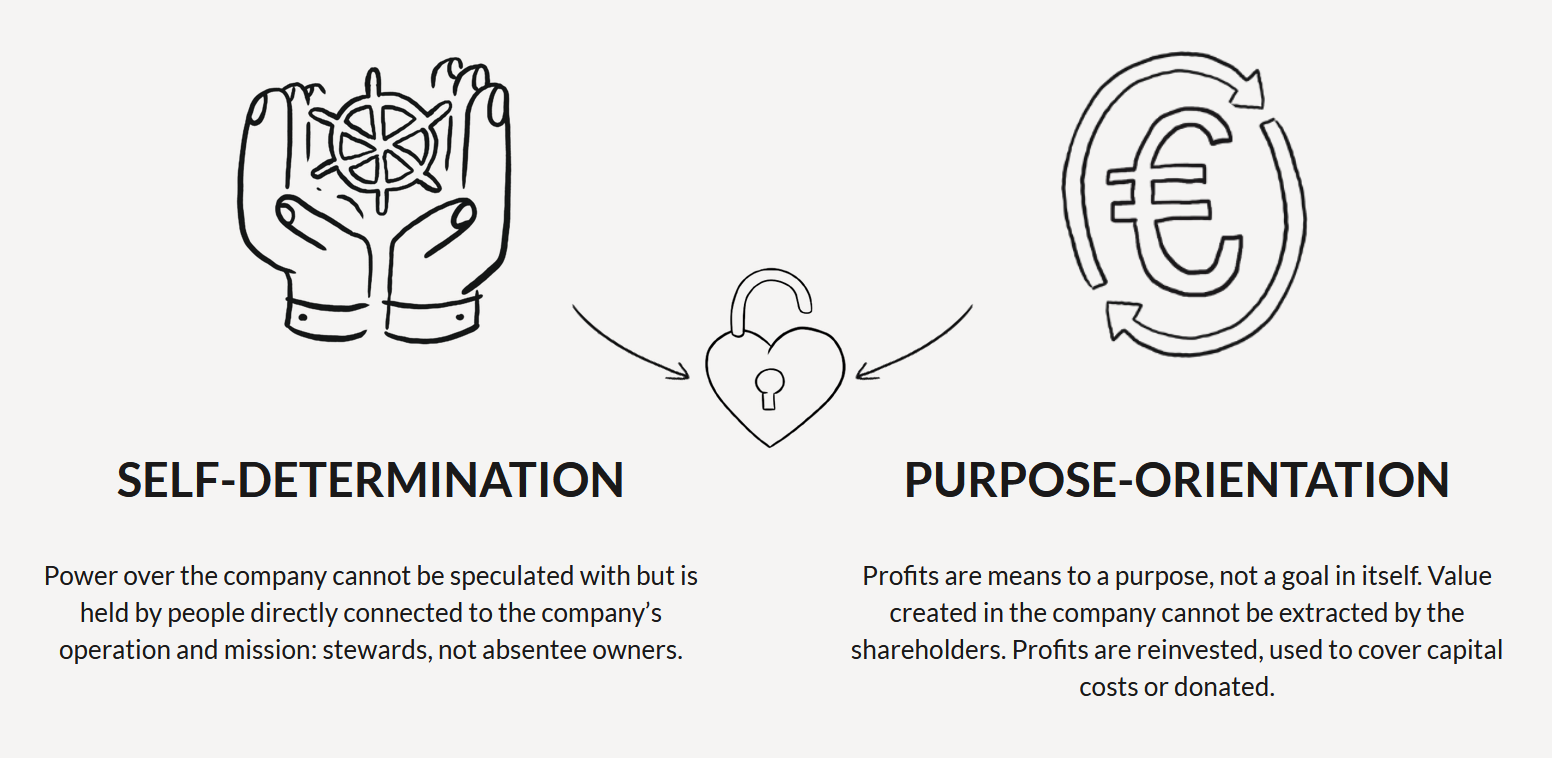
However, anyone having invested $100k or more will have a vote in the Investors Council, which holds one (1) Control Share.
Profit share for investors kicks in when annual founder salaries equal or exceed $75k.
Current Investments
We are currently running on $320k from these investors/benefactors:
- Erlend Sogge Heggen — $200k (external payments plus personal living-cost salary, factored into Founder Pay) (2020-2025)
- Peter Wang — $10k (2025)
- Jeff Atwood — $100k (2025)
- Magne Heggen — $20k (Erlend‘s dad) (2025, 2026)
- other sponsors (full list tba)
All on plainly good-faith, social contracts without any legal-contract formalities, for now.
Re-investment
If the stewardship board agrees, workers may get an opportunity to re-invest their own money into the company in subsequent community-funding rounds.
Dividends
Over the course of 3-15 years, the company will pay back to all its founding stakeholders:
$3.6M + $9M to workers (founders + co-workers), and $7.5M (1.7M+2.8M+3M) to investors—for a total of $20,100,000 in dividends due. (rescaled the numbers a few times, please check them!)
With that paid the company has been ‘made whole’, now fully owned by workers and fellow community stewards; a new addition to the Digital Commons.
After salaries & operation costs, all profits go towards the Company Purpose as determined by co-workers and stewards.
Outstanding Debts
Dividends owed to investors of Roomy, as of 2026:
Workers
- Erlend: $1.5M
- Kapono: $1.5M
- Meri: $750k
- ahq: $200k
- zeu: $40k
- Florian: $40k
- Michael: $20k
- Justin: $20k
- Johani: $20k
- Nandi: $10k
- Sameoldlab: $10k
- Paly: $5k
- Aven: $5k
- Tim: $5k
- Pug: $2k (illustrations, logo)
- FenTiger: $2k
- Emilia: $2k
- bumblefudge: $2k
- PaperPilot: $2k
- LeaChim: $2k
- Anders: $2k
- Esteban $2k
- Harshmangalam: $2k
- Fish: $2k
- JD: $2k
- Tom: $2k
This is everyone’s project. You can just make Roomy better in public, and everyone will know you are a rightful part-owner of Roomy as a commercial venture.
Capital Investors
- Jeff Atwood: $300,000
- Peter Wang: $30k
- Magne Heggen: $60k
- @cdata.earth: $1500
Copy this contract
This is replicable. If you only make it into The Deal for Roomy at the tail-end of it, don't fret, we'll figure out a way for you to spin off your Roomy/atmosphere extension as its own company made in the same mold.