A bridge beyond Discord
Millions of digital communities have already made a home for themselves on Discord, and we'd rather not force them to make a binary choice between the critical mass of members they've built up on Discord and the agency afforded to them on Roomy.

Two years ago I wrote about what makes Discord so sticky among tech workers and why a protocol-based alternative was needed, positing that Matrix could fit the bill.
My intuition that this was a protocol-shaped problem was correct, but the Matrix-protocol turned out to be lacking in essential affordances for high-agency community building, in particular credible-exit and governance.
Thus began our journey to build group chat on the AT protocol, culminating in last week's general-availability announcement of Roomy.
Now we're following that with our first premium feature, a two-way syncing bridge between Discord and Roomy. Here's the tl;dr of my lengthy argumentation attached below today's announcement:
Millions of digital communities have already made a home for themselves on Discord, and we'd rather not force them to make a binary choice between the critical mass of members they've built up on Discord and the agency afforded to them on Roomy.
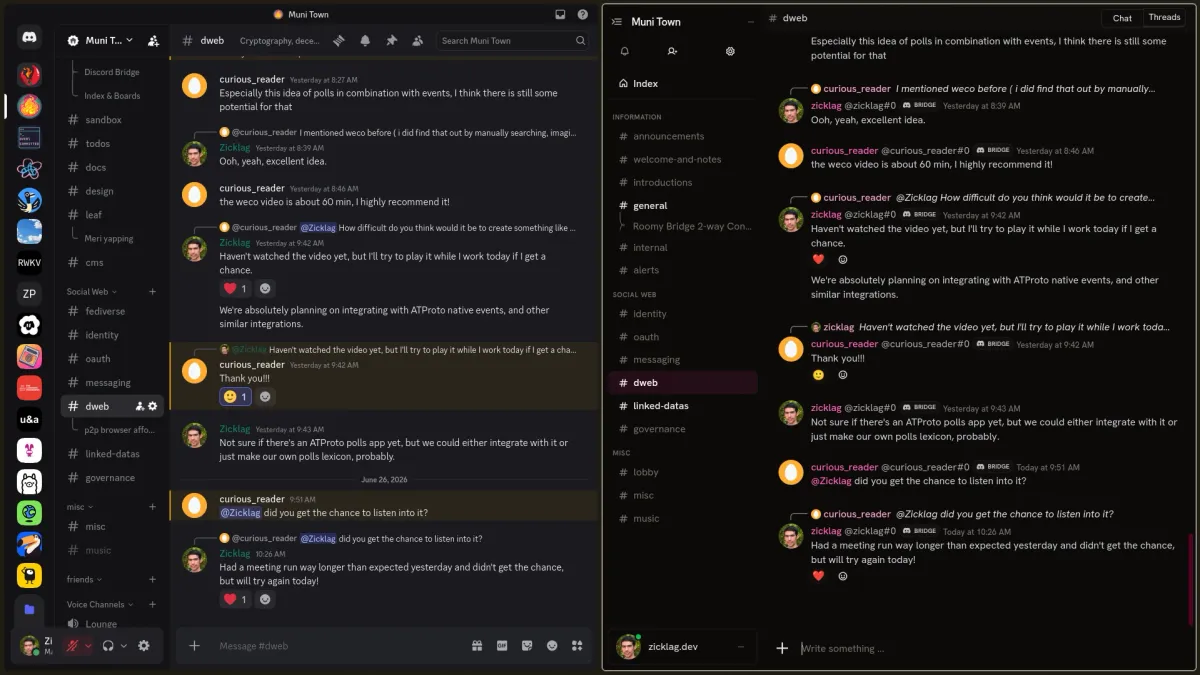
You can try it out by visiting Muni Town's bridged space. There's a #sandbox channel for goofin' around. A more detailed explainer of its capabilities and limitations is forthcoming.
Live demonstration of the same channel bridged between Roomy and Discord.
What makes it a 'premium feature'?
The bridge is freely available to non-commercial users, like open source projects and local organizers. For-profit companies meanwhile can only unlock Discord bridging as a premium feature by paying for it.
Discord bridging comes with risks:
- While bridging isn't against Discord's ToS, spamming is. We can't risk being barred from accessing Discord's API due to malpractice, so the bridge needs to be rolled out gradually and trustfully, one manual approval at a time.
- Bridging is error-prone and demands continuous upkeep. Several organisations a hundred times larger than ours have had to close down free bridging services due to rising maintenance costs.
- While Discord's API is more open than most other social media platforms, we don't like to interact with closed-source software any more than we have to since we have no guarantee of such integrations remaining functional.
Charging for commercial use is the easiest way to mitigate these risks. We intend to combine premium extensions with basic scaling fees as part of a very standard B2B SaaS approach to commercialization.
Want access to the Roomy-Discord bridge? Sign up for our Pro plan!
Non-commercial users get a free pass.
The bridge's source code is openly available, but it's licensed as PolyForm NonCommercial with a countdown to permissive OSS after a year. If that sounds strange to you then read this and get back to me.
For an in-depth argument in favor of bridging as a necessary onboarding mechanism, below is a rewrite of my blog post from two years ago, this time in the context of the Atmosphere.
Exit Strategies
The web is awash with reasons not to use Discord, especially for open source projects. One of the easiest ways to trend on HN is to rant against the use of Discord for open-software comms and information storage:






In spite of countless pleas, not much has changed. Before Discord was the subject of these admonitions, Slack was the popular punching bag:



Minimum Viable Community

Many years ago when I still worked at Discourse we were rather confounded by the prevalence of Slack in open source communities. Their spaces weren't web-readable, it didn't support threads at the time, and users couldn't even join by public link. Either they each had to be invited manually or you'd go through the trouble of setting up a bespoke invite-link service.
Why would anyone in their right mind use Slack for community building when the platform itself didn't really want to be used that way?!
Three reasons:
- Slack was free as a fully hosted service, and the allure of "free" breaks our brains.
- Chat is a superior community starter as a minimum-viable anything.
- Networking effects: 'We're already using Slack for our workplace chat; may as well spin up another instance of it for our community'.
Discourse partially solved for the first two with our free 'groups' plan and in-built chat, although neither was ever fully committed to a total re-framing of Discourse as a viable first stop for community builders; it was always gonna be something you scaled up to rather than starting out with.
As for the missing networking effect, we never got around to that, in spite of some great ideas and founders who had previously made the very successful Stack Exchange network.
Slack maintained its dominance for minimum-viable communities in OSS circles until Discord came along with open invites and an equally ubiquitous network: Gamers. Many open source practitioners are on a Slack/Teams chat for work, but just as many are on at least one casual Discord server for gaming, where we hang out for fun rather than by decree.
Discord also operates more like a social network than Slack:
https://kwokchain.com/2019/08/16/the-arc-of-collaboration/
Beyond its Slack-like functionality, Discord has functionality like a social graph, seeing what games your friends are playing, voice chat, etc. These have been misunderstood by the market. They aren’t random small features. They are the backbone of a central nervous system.
Competing with Network Effects
A legitimate alternative to Discord - as is Roomy's foremost aspiration, for a start - will have to match it on all three aforementioned differentiators, along with some additional edge.
Firstly, how to do freemium without imploding is a very solvable business problem, and I did exactly that once before as the creator of Discourse's free plan.
Secondly, the 'minimum-viable community' problem is solved by making a community platform that's chat-first rather than forum-first, to be incrementally threaded into structured knowledge from there.
The big one - making a network - is simultaneously a technical and social problem. The larger a network is, the more likely users are to join it in order to have access and be accessible to the people who are already there.
Our strategic approach to 'the network problem' can be divided into three pieces:
Open Networks: The Atmosphere
During the user exodus of Twitter and Reddit we witnessed the power of open networks as something which a growing number of netizens understand and seek out in favor of centralized alternatives.
Bluesky seized the moment and quickly amassed millions of users at a much faster pace than its predecessors in the fediverse, in large part thanks to a much simpler onboarding experience underpinned by its novel protocol architecture.
 Kate Knibbs
Graber, a former software engineer, seems most energized when she’s talking about the unique infrastructure for her kingless world. Undergirding Bluesky as well as several smaller apps is the Atmosphere, or AT Protocol, which is a rule book that servers use to communicate. The open source protocol allows sovereign digital spaces to integrate with one another as needed. Two apps with complementary ideas about moderation or ads can work in tandem—or not. It’s up to them.
Graber sees the Atmosphere as nothing less than the democratized future of the social internet, and she emphasizes to me that developers are actively building new projects with it.
The network now counts 45 million members and dozens of high quality apps. 99% of people in the atmosphere were onboarded by the Bluesky platform as the "killer app" needed to kickstart the app-agnostic infrastructure underneath.
What we have now is an open network of 45 million people that any budding social media app can build on top of to supercharge its rise, thus competing on a relatively even footing with the powerful network effects of Big Tech incumbents.
The next 100M members of the atmosphere will come from other startups building atop the AT protocol, and Roomy is one of them.
When the over-leveraged and centralized Discord platform inevitably enshittifies beyond recognition, like Twitter and Reddit before it, Roomy intends to be the best alternative lying around.
Early Adopters: Techies
While the atmosphere's 45M may not yet rival Discord's purported 750M registrants in terms of network size, the most energized participants of the atmospheric extravaganza skews heavily towards geeky tech enthusiasts (like ourselves), which is Roomy's first-mover target market for commercialization.
Specifically, the emerging market of COSS companies, orgs and tech startups developing in the open, which are under constant pressure [1][2] from their constituents to use open & interoperable comms platforms that are credibly decoupled from the global surveillance syndicate.
Roomy is positioning itself as an open and federated Discord-alternative for primarily public-facing communities and organisations that find themselves disenfranchised by traditional social media.
 Erlend Sogge Heggen
Adversarial Interoperability: Bridging
Big network incumbents are very hard to leave, especially the ones with profound utility like Discord. The stickiness of these mainstream apps is such that it's not enough to simply build a more attractive product.
No matter how cool your new place is, you're asking the masses to leave the comfort of their familiar metropolis for your remote cottage town. That's the 'collective action problem' in a nutshell. Millions of digital communities have already made a home for themselves on Discord, and we'd rather not force them to make a binary choice between the critical mass of members they've built up on Discord and the agency afforded to them on Roomy.
Unlike Twitter and Reddit which have made their APIs pay-to-play, Discord remains open enough for other applications to integrate with it. This has enabled us to create a bridge between Discord's guilds/servers and Roomy's spaces, syncing messages between the two.
Bridging is a very common transitioning tactic. Slack first launched with a very capable bridge to IRC, thus enticing the internet-old curmudgeons like me to give it a try. First via the comfort of my familiar client, then they reeled us all into their proprietary platform with all those 'cool extra features' that IRC didn't have.
Facebook did the same thing with MySpace whilst making sure the same tactic could not be used against them.
Bridging is adversarial interoperability at its finest, enabling an incremental, non-disruptive transition from the old to the new, or just an ongoing compatibility layer between CoolApp and SwaggyApp.
While we're not violating any ToS, it's true that by spelling out our intentions in the open we're running the risk of Discord-corp lashing out. But with the winds of (European) regulation blowing in our favor, we'd frankly advise Discord against doing anything rash. We'd much rather do amicable rather than adversarial interop 💞
Roomy's Edge
A protocol-based alternative to Discord is a good start and an innovation in its own right when taking open business development and interoperability into account, but there's no reason we should stop there.
Roomy aspires to elevate the group messaging paradigm to new heights. From where we're standing, digital comms tooling has only achieved 1/10th of the full potential of what's possible with the tech we've already got right in front of us.
You'll be amazed what can be achieved with software that's structurally incentivized to elevate rather than control its beneficiaries.
Next
Coming next we'll be exploring our added "edge" thusly:
- Federated webrings & communal interweaving
- Atmospheric interop.
- Web-public, linkable threads & messages.
- Sign everything to facilitate socialized proof of work.
- Message gardening: chat message ➡️ forum thread ➡️ long-form article.
- Chat as glue.